Tennessee Drug DUI Saliva Test Law: Oral Fluid Testing, Implied Consent, and Your Defense
Key Takeaways
Tennessee now uses roadside saliva tests for drug DUI investigations, and this article provides quick, practical answers about what that means for you before diving into the details.
As of 2025–2026, Tennessee's implied consent law (Tenn. Code Ann. § 55-10-406) expressly includes oral fluid, meaning refusing a saliva test can suspend your driver's license even if DUI charges are later reduced or dismissed.
Saliva tests detect drug presence (THC, opioids, benzodiazepines, stimulants) long after actual drug impairment ends—this gap is often central to a strong DUI defense.
Starting January 1, 2026, the penalty for refusing a blood test increases to an 18-month license suspension for first-time offenders without prior convictions.
Officers may still seek a search warrant for a blood draw after a refusal, and both saliva and blood tests can be challenged on scientific, procedural, and constitutional grounds.
A refusal to submit to a chemical test in Tennessee can be charged as a separate implied consent violation, even if a warrant is later obtained for a blood draw.
Facing a saliva-based DUI in Nashville or surrounding counties? Call Ryan Terrell Law, PLLC at (615) 200-0449 or message us securely online for a focused DUI defense review.
Introduction: How Oral Fluid Testing Is Changing Tennessee Drug DUI Stops
Tennessee DUI stops used to follow a predictable pattern: field sobriety tests, breath tests for alcohol consumption, and blood draws for suspected impaired driving. But since statutory changes in 2024–2025, troopers and city police officers across Middle Tennessee now deploy quick roadside saliva swabs for suspected drug impairment.
On May 5, 2025, Tennessee introduced a one-minute roadside saliva screen that can detect THC, fentanyl, and various prescription drugs before a law enforcement officer writes a citation. The 2024 amendment to Tenn. Code Ann. § 55-10-406 added oral fluid to the list of chemical tests covered by implied consent, expanding enforcement tools for driving under the influence of drugs.

These tests are already being used in Nashville (Davidson County), Murfreesboro (Rutherford), Franklin (Williamson), Gallatin (Sumner), Lebanon (Wilson), and Springfield (Robertson). Courts are just beginning to wrestle with their reliability and admissibility in DUI cases.
Here's what you need to know: Tennessee's implied consent law requires drivers of a motor vehicle to submit to chemical testing if lawfully arrested for DUI, which now includes saliva tests as of May 5, 2025. Refusing a lawfully requested saliva test triggers civil license suspensions. And critically, presence of a drug in your saliva does not equal impairment—a distinction that can make all the difference in your defense.
If you've recently been swabbed or charged with a saliva-based drug DUI, call (615) 200-0449 or contact us online for a prompt review of your stop and test.
How Tennessee Added Saliva to Its DUI Implied Consent Law
Tennessee did not always allow roadside oral fluid testing. The shift came through specific legislative changes aimed at drugged driving, especially after concerns about fentanyl and THC-impaired drivers grew statewide.
Under Tennessee law, Tenn. Code Ann. § 55-10-406 establishes the implied consent framework. The 2024 legislative amendments explicitly folded oral fluid into the list of authorized chemical tests. As of January 1, 2026, Tennessee law allows law enforcement to use oral fluid (saliva) testing during DUI investigations to detect drugs and alcohol.
Lawmakers argued that blood draws were too slow for certain fast-metabolizing substances. The Tennessee Highway Safety Office responded by deploying 24 testing devices to select agencies to enhance drug-DUI enforcement. Unlike alcohol DUIs, where a legal limit such as 0.08% BAC is established, drug DUIs in Tennessee rely on evidence of impairment rather than a set legal limit. The new law applies whether the traffic stop occurs in Metro Nashville, Murfreesboro, Franklin, Gallatin, Lebanon, or Springfield—though local enforcement practices and court attitudes vary depending on the county.
What Actually Happens During a Tennessee Saliva DUI Stop
Picture this: you're pulled over late at night for weaving or speeding. The police officer observes bloodshot eyes, smells marijuana, or notes your admission to using prescription medication. After administering field sobriety tests, they request an oral fluid sample.
The saliva test procedure requires officers to observe the driver for two minutes before swabbing the inside of each cheek, followed by inserting a cartridge into a reader for analysis. The procedure involves a cheek swab that tests for substances including THC, cocaine, and opioids, similar to how a breathalyzer test functions for alcohol.
Many Tennessee agencies use the Dräger DrugTest 5000 or similar devices. The Dräger DrugTest 5000 can detect parent THC for about four hours, opioids for up to 24 hours, and synthetic stimulants for two hours after use. These devices have specific calibration, maintenance, and operator-training requirements that DUI defense lawyers scrutinize closely.
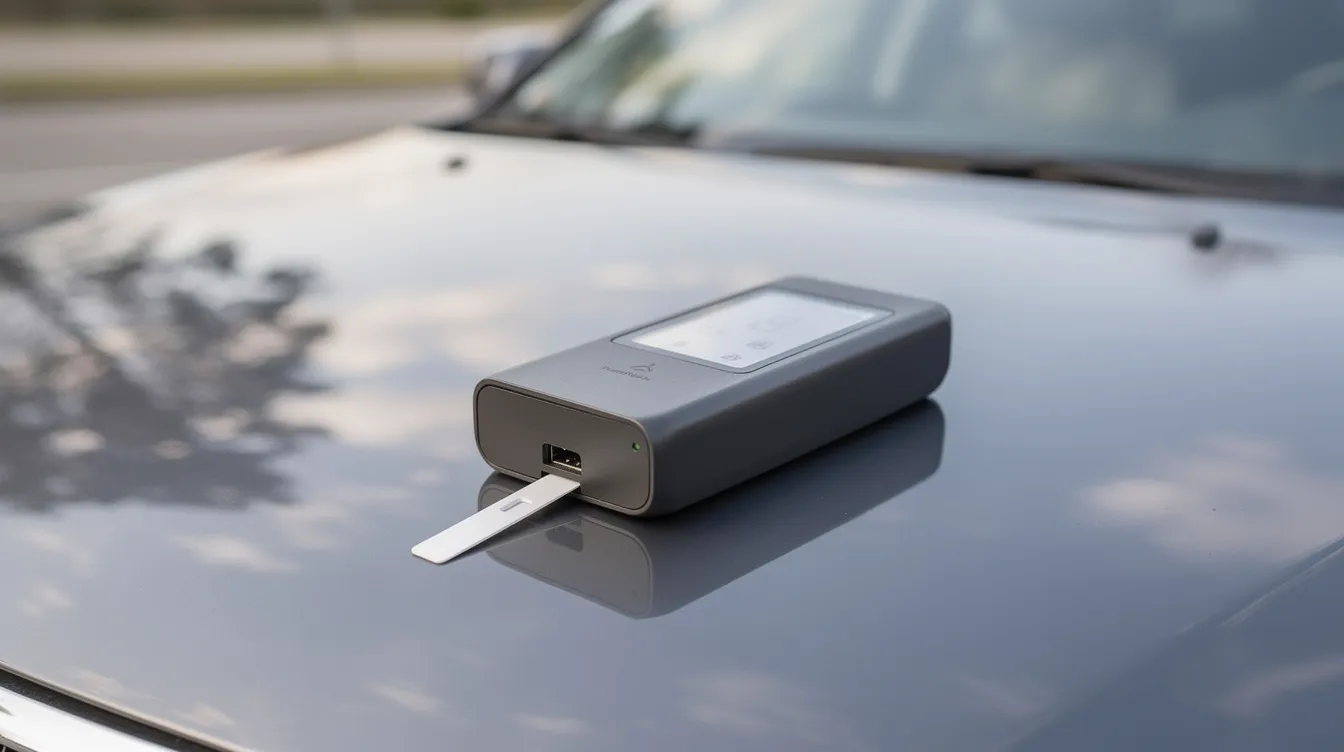
A positive roadside saliva screen can be used as probable cause to obtain a search warrant for a blood draw. If you're tested, try to remember:
The name/model of the device
The time of the test
Recent eating, drinking, or oral medications
Whether the officer properly sealed and labeled the sample
Implied Consent, Refusal, and Saliva: Civil Penalties and Criminal Consequences
By driving on Tennessee roads, you are deemed to have given consent to certain chemical tests—breath tests, blood tests, urine tests, and now saliva tests—if an officer has probable cause to believe you are impaired.
Under Tennessee's implied consent law, refusal to submit to a requested chemical test can be charged as its own violation, separate from any DUI charge, which can lead to additional penalties. The 2025 amendment to Tennessee's implied consent law imposes the same civil penalties for refusing a saliva test as for refusing a breath test, including a one-year suspension for a first refusal.
Refusal Type |
Before Jan 1, 2026 |
After Jan 1, 2026 |
|---|---|---|
First Refusal |
1-year suspension |
18-month suspension |
Second Refusal (within 10 years) |
2-year suspension |
2-year suspension |
Third+ Refusal |
5-year suspension |
5-year suspension |
Even if you refuse the roadside saliva test, officers who believe they have probable cause may seek a telephonic or electronic warrant for a blood sample. Courts generally treat blood tests as more robust evidence, but both remain open to challenge.
Why do some drivers still choose refusal? To prevent the State from gaining questionable scientific evidence that shows only presence, not impairment. This is a strategic legal question—discuss it with a DUI attorney immediately after a DUI arrest.
Presence vs. Impairment: The Scientific Weakness of Saliva Drug Tests
Here's the core scientific problem with oral fluid testing: saliva tests are good at detecting whether certain drugs or metabolites are present in your saliva. They are poor at telling whether you were actually experiencing drug impairment at the time of driving.
A positive saliva test does not automatically equate to admissible evidence; officers must still obtain a confirmatory blood draw to match the oral-fluid results with a toxicology report. THC and its metabolites can remain detectable in saliva for hours or even days after last use. Prescription drugs like benzodiazepines, stimulants, or opioids can linger without causing current impairment.
Additional vulnerabilities include:
Environmental contamination: Secondhand cannabis smoke or contact with contaminated surfaces
Oral products: Mouthwash, numbing sprays, or over the counter medications causing false positives
Device issues: Improper storage, transport, or delayed analysis of samples
Cross-reactivity: CBD oils or hemp products triggering positive results
At Ryan Terrell Law, PLLC, our defense strategy includes working with toxicologists and reviewing Tennessee Bureau of Investigation lab documentation to separate mere presence from actual impairment beyond reasonable suspicion.
Challenging Saliva Evidence in Tennessee Drug DUI Cases
Saliva-based DUI charges are defensible. Challenging oral fluid results is often the centerpiece of a successful strategy in Middle Tennessee courts.
Key legal attack points:
Lack of reasonable suspicion for the initial traffic stop
Insufficient probable cause for a DUI investigation
Incomplete or confusing implied consent warnings
Problems obtaining or executing any blood-search warrant
Scientific and evidentiary challenges:
Demanding calibration and maintenance records for the oral fluid device
Scrutinizing officer training on the specific model used
Attacking breaks in chain of custody from roadside collection to lab analysis
Saliva test results are admissible as evidence in criminal court cases—but only if proper testing procedures were followed. Tennessee Rules of Evidence require authentication and reliability foundations. Successful challenges can lead to suppression of saliva evidence, weakening the prosecution's case enough to secure dismissals or reduced charges like reckless driving.
Practical Action Plan If You've Been Tested with a Saliva Swab
A DUI arrest feels overwhelming. But early intervention and informed steps can make all the difference in achieving a favorable outcome.
During the stop:
Remain calm and polite
Provide license, registration, and insurance
Avoid volunteering details about prescription medication or prior use without counsel
After arrest:
Clearly state you want to speak with an attorney
Ask that all interactions be captured on bodycam or dashcam
After the swab: Write down immediately:
Time of the test
Anything eaten, drunk, smoked, vaped, or used orally in the prior hour
Any medical or dental treatments that might explain results
Critical deadline: A Notice of Proposed Suspension may require scheduling an administrative hearing within 10–14 days. Contact a DUI defense lawyer immediately to preserve your rights and challenge the implied consent violation.
How Ryan Terrell Law, PLLC Defends Saliva-Based Drug DUI Charges
Ryan Terrell Law, PLLC is a Nashville-based criminal defense practice that regularly handles DUI cases involving saliva, blood, and breath tests throughout Davidson, Rutherford, Williamson, Sumner, Wilson, and Robertson Counties.

Our evidence-driven approach includes:
Obtaining police reports, incident narratives, and dashcam/bodycam footage
Reviewing implied consent advisement forms
Analyzing detailed lab documentation for both saliva and follow-up blood draws
Consulting with toxicologists and pharmacologists to interpret oral fluid results
Identifying alternative explanations consistent with lawful behavior
Our experienced legal team collaborates closely to build a strong defense for clients facing saliva-based DUI charges, ensuring every aspect of the case is thoroughly examined.
Our legal team's familiarity with local courts in Nashville, Murfreesboro, Franklin, Gallatin, Lebanon, and surrounding jurisdictions helps tailor strategy to particular judges and docket practices.
Ready for a confidential case evaluation? Call Ryan Terrell directly at (615) 200-0449 or send a detailed message through our secure online form.
Penalties and Real-World Consequences of a Saliva-Based Drug DUI
A positive saliva test contributing to a DUI conviction carries the same penalty structure as an alcohol DUI in the criminal justice system, even for a first time offender. If you are found guilty of a drug DUI, these penalties will apply.
First-offense misdemeanor DUI consequences:
Penalty |
Details |
|---|---|
Jail Time |
Minimum 48 hours (up to 11 months 29 days with aggravators) |
Fines |
Starting at $350 plus court costs |
License Revocation |
One year |
Additional Requirements |
Ignition interlock device, 12-hour DUI school |
A positive saliva test can lead to significant life impacts: doubled insurance premiums, loss of rideshare job opportunities, and potential disciplinary actions for professional licenses. CDL holders can find their careers severely impacted by even a first implied consent violation.
Independent of criminal charges, a saliva-based implied consent refusal triggers a stand-alone one year suspension (18 months post-2026), affecting daily life even if DUI charges are dismissed.
Don't let a misdemeanor DUI or implied consent violation create serious consequences for your future. Speak with a defense lawyer before pleading guilty.
Why Work with a Nashville Criminal Defense Lawyer on Saliva DUI Cases
Tennessee law around oral fluid testing is rapidly evolving. Experienced local counsel makes a decisive difference in how evidence is challenged and presented in legal proceedings.
A Nashville-based criminal defense lawyer like Ryan Terrell understands how Davidson and surrounding county courts treat saliva tests, which arguments have been persuasive in recent hearings, and what procedural mistakes local agencies tend to make. His broader criminal defense background—including drug possession, drunk driving, and related offenses—allows him to spot collateral risks like probation violations or overlapping criminal charges.
The firm's practice groups in civil litigation and business law can also address spillover issues like employment disputes triggered by a license suspension.
Charged with a saliva-based drug DUI? Call (615) 200-0449 or reach out online before crucial court or Department of Safety deadlines pass.
Take Action Now: Protect Your License, Record, and Future
Saliva-based DUI cases move quickly. Early administrative hearings can lock in license suspensions if they go unchallenged. Short windows exist to request hearings on implied consent suspensions. Dashcam and bodycam footage must be preserved. Engaging a lawyer before speaking further with law enforcement gives you an advantage.
Contacting counsel does not mean admitting guilt—it's a necessary step to understand your rights, evaluate test evidence, and explore all available defenses.
Officers may obtain a saliva sample without additional consent if the driver is incident to a lawful DUI arrest, a search warrant is obtained, or exigent circumstances exist. Tennessee law even allows police to use reasonable force to obtain samples if a search warrant has been issued.
Don't wait. Call Ryan Terrell Law, PLLC at (615) 200-0449 right away or send a secure message through our online contact form to schedule a confidential consultation about your Tennessee saliva DUI case.
Frequently Asked Questions About Tennessee Drug DUI Saliva Tests
Does Tennessee's saliva DUI law apply to prescription medications?
Tennessee's DUI statute covers impairment by any intoxicant, including lawfully prescribed prescription drugs like painkillers, anxiety medications, or ADHD stimulants, if they render a driver unable to drive safely. Saliva tests don't distinguish between legally prescribed and illegally obtained versions of certain drugs—they simply show presence. Drivers with valid prescriptions should seek legal counsel because defense often turns on dosage, timing, tolerance, and absence of actual impairment.
Can I insist on a blood test instead of a saliva test in Tennessee?
Officers generally choose the type of test under Tenn. Code Ann. § 55-10-406, and drivers do not have an absolute right to demand a different test at the roadside. In many DUI cases, a positive saliva screen is followed by a warrant-based blood draw anyway. If you request a blood test and the officer refuses, that fact may become relevant in challenging the investigation, but it doesn't guarantee dismissal.
What happens if my saliva test is positive but my blood test is low or negative?
Discrepancies between saliva and blood results aren't uncommon, especially when delays occur between the roadside swab and later blood draw. Defense counsel can use low or negative blood results to undercut the saliva screen's significance, arguing any detected substance was residual and not causing impairment. Such inconsistencies support motions to exclude evidence or persuade prosecutors to reduce charges.
Are saliva tests more accurate than breath tests for drugs?
Breath tests are designed primarily for measuring blood alcohol content, while saliva tests screen for various drugs like THC, opioids, benzodiazepines, and stimulants. Neither offers a perfect snapshot of actual impairment. While saliva detects more drug types, results remain vulnerable to detection windows, contamination, and calibration problems. Blood tests remain the gold standard for many substances in DUI accidents and serious cases.
Do I really need a lawyer if I plan to plead guilty?
Even if you think you want to plead guilty, speak with a DUI attorney first. There may be viable defenses, evidentiary weaknesses, or alternative resolutions you're unaware of. A DUI conviction creates lasting consequences—substantial fines, jail time, and impacts on employment and professional licenses—that can sometimes be mitigated through negotiated agreements. Contact Ryan Terrell Law at (615) 200-0449 or use our online form for advice specific to your situation.